

If your books are behind, the fastest, lowest-risk move is to book a scoped backlog assessment with a bookkeeping professional this week, not to try to reconcile eighteen months of transactions yourself on a Sunday night. A real catch-up bookkeeping engagement gives you three things almost immediately after intake: a reconciled bank balance you can trust, a path to a tax-ready trial balance, and a written scope with a cost estimate attached to it.
That last part matters more than people expect. Vague promises ("we'll get you caught up") aren't a scope. A proper backlog assessment tells you how many months you're behind, what documents are missing, and what it will cost to fix, before you sign anything. Most firms worth hiring offer a free consultation to get you that answer, and many specialize in QuickBooks Online specifically because it's the platform most small businesses already have, half set up, sitting there waiting to be finished.
If you're reading this at 11 p.m. because your accountant just asked for financials you don't have, here's the short version: request an estimate, get a scope in writing, and start with the most recent unreconciled period first. Everything else in this guide fills in the details.
Key Takeaways
Catching up your books requires a scoped assessment, per-period reconciliation to your filed returns, and a documented handover, not a quiet one-time adjustment.
| Point | Details |
|---|---|
| Start with a scope | Book a backlog assessment before agreeing to any price so the estimate reflects your actual transaction volume and document gaps. |
| Cost tracks backlog size | Expect pricing to rise with months behind, transaction volume, payroll complexity, and missing source documents. |
| Timeline varies widely | A 1–3 month backlog can close in days to weeks; 12+ months can take multiple months depending on documentation. |
| Gather documents first | Bank and card statements, payroll summaries, vendor invoices, and prior filed returns speed up every engagement. |
| Carlisle Bookkeeping's approach | Offers a free consultation, QuickBooks Online expertise, and per-period reconciled trial balances with documented handover. |
Table of Contents
- What Catch-Up Bookkeeping Actually Delivers
- How Do Professionals Actually Catch Up Your Books?
- How Much Does Catch-Up Bookkeeping Cost?
- How Long Does It Take to Get Caught Up?
- Do You Actually Need Catch-Up Bookkeeping Right Now?
- How to Choose the Right Catch-Up Bookkeeping Service
- What Working With Carlisle Bookkeeping Looks Like
- Ready to Get Your Books Current?
- Sources
What Catch-Up Bookkeeping Actually Delivers
Catch-up bookkeeping is the process of bringing your accounting records up to date after you've fallen behind, and the work almost always includes bank and credit-card reconciliations, transaction coding, cleanup of miscategorized entries, and a final review so your reports mean something again. That's the industry definition, and it's worth knowing because "catch-up" gets used loosely online to describe everything from a light cleanup to a full forensic rebuild.
The actual deliverables you should expect from a competent engagement look like this:
- Per-period reconciliations for every bank and credit card account, month by month, not one lump adjustment for the whole year.
- Reconciled trial balances for each closed period, so your accountant or lender sees numbers that tie out.
- Prior-period adjustment schedules documenting exactly what changed and why, not silent overwrites of old entries.
- Supporting schedules for loans, payroll, and sales tax that reconcile to the actual filed returns.
- A remediation and handover list flagging anything still unresolved (missing statements, unexplained deposits) so you know what's still open.
The per-period close matters because each year should be closed on its own and rolled forward into the next, creating an audit trail a lender or the IRS could actually follow. Rebuilding the ledger this way typically works backward from the last reconciled bank balance, closing each older period individually rather than smoothing everything into one big catch-all adjustment, according to Patron Accounting's breakdown of backlog work.
Before you hire anyone, run their proposal against this checklist:
- Does it name specific per-period deliverables, or just "get you caught up"?
- Does it mention reconciling to your filed tax returns, not just to your bank feed?
- Is there a written remediation list for anything that can't be resolved?
- Does it specify who owns your data and login credentials after the project ends?
Pro Tip: Insist that any differences between your rebuilt books and your already-filed tax returns get documented in writing, not quietly adjusted away. A bookkeeper who "makes it match" without showing you the delta is hiding information you may need later if the IRS ever asks questions.
How Do Professionals Actually Catch Up Your Books?
The workflow is fairly consistent across firms that do this well, even if the vocabulary differs. Here's the sequence in practice:
- Intake and backlog scoping. The bookkeeper reviews what you have, how far behind you are, and which accounts and entities are involved.
- Prioritizing periods. The most recent or most urgent period (the one your lender or accountant needs first) gets worked first, even if older periods aren't finished yet.
- Reconstructing transactions. Missing entries get rebuilt from bank feeds, statements, and receipts, not guessed at.
- Reconciling bank and card accounts. Every account gets matched to its statement balance, period by period.
- Resolving clearing and suspense accounts. Unidentified deposits and payments get chased down or clearly flagged as unresolved.
- Posting prior-period adjustments. Corrections get documented with a schedule showing what changed.
- Producing reconciled trial balances. Each closed period ends with a clean, reviewable trial balance.
- Review and sign-off. You review the output before it's considered final, and before it goes to your CPA or tax preparer.
Getting through that sequence quickly depends almost entirely on what you hand over up front. A short onboarding checklist saves weeks:
- Read-only or admin access to your accounting software and bank/merchant portals.
- A list of every bank, credit card, and merchant processor account tied to the business.
- User roles and any existing passwords or access credentials.
- Payroll records and loan documents, including amortization schedules.
- Prior filed tax returns for the periods being reconstructed.
The IRS actually publishes guidance on what business records to keep, covering bank statements, sales invoices, payroll records, and expense documentation. Pulling that list before your first call with a bookkeeper will save you a week of back-and-forth emails. If contractors are involved, you'll also want W-9 forms on file for anyone you paid, since that documentation feeds directly into 1099 accuracy.
Professionals verify their own work through source-document tie-outs, literally matching every reconstructed entry back to a bank statement or invoice, and through per-period reconciliation reports you can review as they go. Ask for interim reports rather than waiting for one final delivery at the end; it's the only way to catch a misunderstanding before it compounds across six months of entries.

How Much Does Catch-Up Bookkeeping Cost?
Pricing depends mostly on how far behind you are and how messy the accounts are, and the honest range is wide because the inputs vary so much. Here's a realistic breakdown by backlog size:
| Backlog Size | Typical Scope | What Drives the Price |
|---|---|---|
| Small (1–3 months) | Single entity, one or two bank accounts, low transaction volume | Transaction count, whether receipts are organized |
| Medium (4–12 months) | Multiple accounts, some payroll or sales tax activity | Payroll complexity, commingled personal/business spending |
| Large (12+ months) | Multiple entities, missing statements, possible prior filed returns needing review | Missing source documents, need for amended filings |
The variables that move price the most, in order of impact:
- Months behind. Every additional month is another reconciliation cycle, not just more data entry.
- Monthly transaction volume. A business with 40 transactions a month costs far less to reconstruct than one with 400.
- Number of accounts and entities. Multiple bank accounts, credit cards, or separate legal entities multiply the reconciliation work.
- Payroll and sales tax complexity. Reconciling payroll liabilities and multi-state sales tax adds specialized review time.
- Missing source documents. If bank statements need to be requested from the bank itself, that alone can add a week and a fee.
- Prior-period tax amendments. If differences surface between the books and already-filed returns, deciding whether to amend adds cost and time.
Providers typically price this work three ways: hourly for small, unpredictable cleanups; flat project fee once the scope is defined, which is usually the fairest option for a defined backlog; or monthly ramp pricing, where you pay a set catch-up fee and then roll straight into an ongoing monthly bookkeeping plan once you're current. Flat-fee pricing makes the most sense once someone can actually see your books and count the accounts involved, which is why a scoping call matters more than a quick phone quote.
To get an estimate you can actually compare across providers, hand over the same details to each one: an approximate transaction count for a sample month, how many months you're behind, and which system you use (QuickBooks Online, spreadsheets, or something else). Vague requests get vague quotes. Specific requests get real pricing.
How Long Does It Take to Get Caught Up?
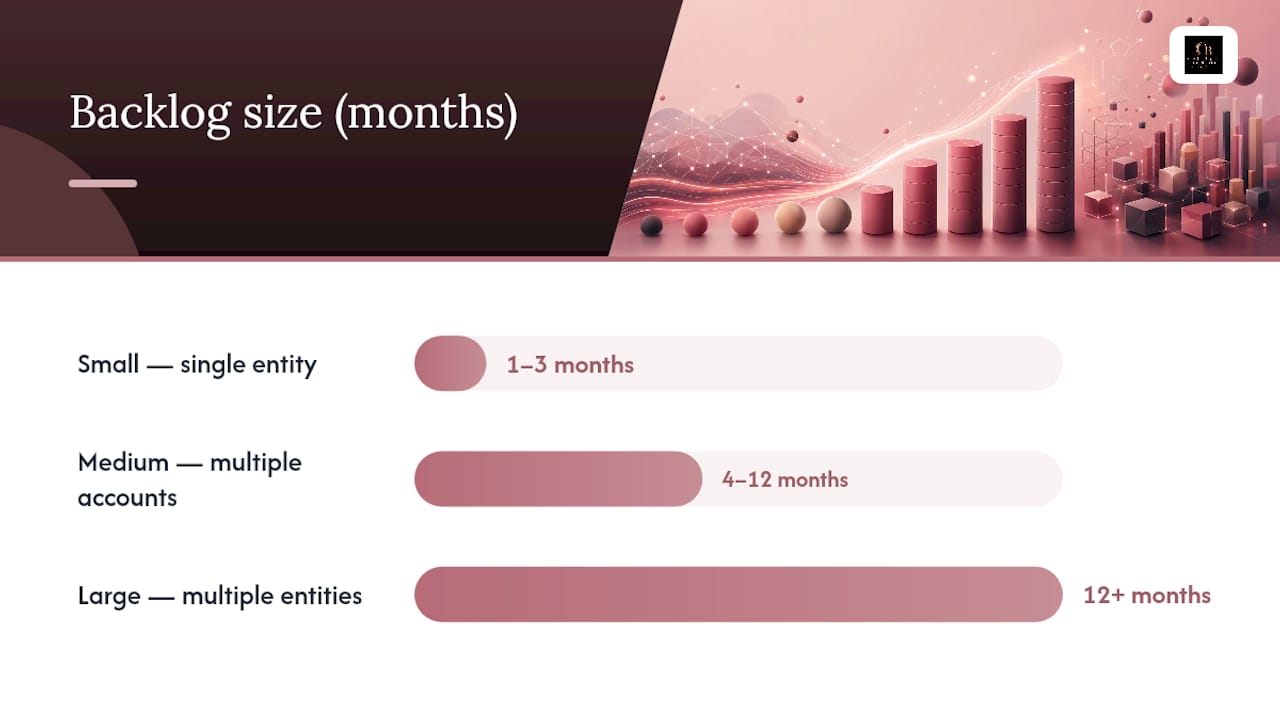
Timeline tracks backlog size almost exactly the way cost does, though document availability can swing either number significantly.
- 1–3 months behind: Often days to a couple of weeks, assuming statements and receipts are on hand.
- 4–12 months behind: Typically 2 to 8 weeks, depending on transaction volume and how many accounts are involved.
- 12+ months behind: Multiple months in many cases, largely dictated by how much documentation has to be requested or reconstructed from scratch.
The bottlenecks that stretch these timelines are almost always the same handful of things:
- Missing bank statements that have to be requested from the bank directly.
- Vendors or payment processors who are slow to respond to document requests.
- Gaps in payroll history that require reconstructing W-2 and payroll tax records from scratch.
- Multi-entity files where transactions bleed across two or more businesses without clear separation.
You can meaningfully speed things up on your end. Gather every bank and credit card statement you can find before the first call. Grant direct read access to accounts rather than forwarding PDFs one at a time. Tell your bookkeeper which period matters most, whether that's the one your lender needs or the one your tax deadline is tied to, so it gets worked first. And designate one person on your team as the single point of contact; bookkeepers lose real time chasing down answers from three different employees who each have half the picture.
Pro Tip: If someone promises to catch up eighteen months of tangled books in three days, be skeptical rather than relieved. Speed that ignores source-document verification just moves the risk from "your books are late" to "your books are wrong," and wrong books cause bigger problems at tax time than late ones ever did.
Do You Actually Need Catch-Up Bookkeeping Right Now?
Some situations call for immediate professional help, and others can reasonably wait for a scaled, internal fix. The clearest signals that you need help now:
- Your bank accounts haven't been reconciled in 60 days or more.
- You can't explain why your cash balance changed from one month to the next.
- You're estimating payroll or sales tax liabilities instead of calculating them from actual records.
- You're applying for a business loan or bringing on an investor who will ask for clean financials.
- You're missing vendor invoices, merchant processor reports, or payroll summaries entirely.
If none of those apply and you're simply a few weeks behind with all your documents on hand, a focused weekend with your accounting software might genuinely close the gap yourself. But once you cross 60 days unreconciled, or once a lender or tax deadline enters the picture, the math changes: the cost of a professional catch-up is almost always smaller than the cost of an inaccurate loan application or a tax filing built on guesses.
The consequences of waiting compound quietly. Inaccurate books lead to inaccurate tax filings, which can trigger penalties or amended returns later. Lenders decline financing when financials don't reconcile. And unreconciled payroll accounts can hide real liabilities, unpaid withholdings or missed deposits, that only surface once a tax authority notices. Maintaining accurate, well-documented books also matters beyond taxes: courts have pierced the corporate liability shield in cases where a business failed to keep credible financial records, treating sloppy books as evidence the business and its owner weren't truly separate.
How to Choose the Right Catch-Up Bookkeeping Service
Not every provider who says "we do catch-up bookkeeping" actually has a documented process for it. Here's what separates the ones who do from the ones who are guessing along with you.
Selection checklist:
- Demonstrated QuickBooks Online expertise, since that's the platform most small businesses are already using.
- Specific experience with backlog and reconstruction work, not just monthly maintenance bookkeeping.
- A documented, repeatable process for per-period reconstruction, not an ad hoc approach.
- References or examples of comparable engagements they've completed.
- A clear, written scope of deliverables before work begins.
Questions worth asking in an interview or discovery call:
- How do you define the scope, and what happens if the backlog turns out to be bigger than expected?
- What's your reconciliation methodology, and will I see interim reports as you go?
- Who on your team actually does the reconstruction work, and who reviews it?
- If you find differences between my filed tax returns and the rebuilt books, how do you handle that?
- What's your realistic timeline, and how will you report milestones along the way?
Red flags that should make you walk away: a provider who won't define scope in writing, anyone who promises to "make the returns match the books" without explaining how or disclosing what changed, no written reconciliation reports at any point, and no clear plan for how account access and data ownership work once the engagement ends.
It also helps to understand the difference between basic tracking tools and specialized backlog services, since they solve different problems:
| Evaluation Criteria | Entry-Level Field Apps | Specialized Bookkeeping Services |
|---|---|---|
| Best suited for | Ongoing day-to-day entry once books are current | Reconstructing and reconciling a backlog |
| Reconciliation depth | Automated matching, limited manual review | Per-period, source-document tie-out |
| Handles filed-return discrepancies | Generally no | Documented schedule of differences |
| Human review and sign-off | Limited or none | Built into the process |
A budget app can keep you current once you're caught up. It generally isn't built to untangle eighteen months of miscategorized transactions and missing statements on its own.
What Working With Carlisle Bookkeeping Looks Like
Carlisle Bookkeeping LLC approaches catch-up work the same way this guide describes it should be done: backlog scoping first, then per-period reconciliation, source-document tie-outs, and a documented handover once your books are current. That sequencing exists for a reason. Skipping straight to "let's just fix it" without scoping first is how projects run over budget and over timeline.
Clients working with Carlisle Bookkeeping can expect a few concrete things:
- A single point of contact for the duration of the catch-up engagement, rather than being routed between different staff each time.
- Interim reconciliation reports as periods get closed, not one black-box delivery at the end.
- Final reconciled trial balances for every period covered, ready to hand to your CPA or tax preparer.
- Deep familiarity with QuickBooks Online, since it's the platform most clients arrive with already.
A reconciled trial balance for every closed period, backed by a documented list of any differences against what you already filed, is what "caught up" should actually mean, not a vague assurance that the numbers "look right now."
You can review Carlisle Bookkeeping's credentials and background before reaching out, and the services page breaks down exactly what a catch-up engagement includes alongside ongoing monthly bookkeeping options.
A note on priorities from Cristal
If you take one thing from this guide, let it be this: don't wait for the "right time" to fix your books, because there isn't one. The businesses that get into real trouble aren't the ones that fell behind, they're the ones that stayed behind for another six months hoping the problem would somehow get smaller. It doesn't. A scoped catch-up engagement, priced honestly and reconciled period by period, is the single most reliable way I've seen small business owners actually get unstuck. Once you're caught up, the real win is staying there: a disciplined monthly close prevents you from ever needing this guide again.
Ready to Get Your Books Current?
Carlisle Bookkeeping LLC offers a scoped, fixed-price path out of a bookkeeping backlog instead of an open-ended hourly bill that grows every time your file turns out messier than expected. That difference matters most in the exact moment you're deciding whether to hire help: you get a real number before you commit, not after.
The process starts with a free consultation to assess how far behind you are and what it will take to fix it, no obligation attached. From there, you'll get per-period reconciliations, a documented schedule of any differences against your filed returns, and a final reconciled trial balance ready for tax season. Carlisle Bookkeeping specializes in QuickBooks Online, so if that's your system, setup and integration are already familiar territory rather than a learning curve tacked onto your catch-up project.
If you already know roughly how far behind you are, request a pricing estimate directly, or browse the full range of services to see what's included once your books are current and you move into ongoing monthly bookkeeping.
Sources
The IRS remains the most authoritative reference for the documentation side of this work: its recordkeeping guidance lists exactly which records matter, its retention rules explain how far back you may need to reconstruct, and its contractor reporting guidance covers 1099 obligations that often surface during a catch-up review.
Before your next call with a bookkeeper, three things will make the process faster:
- Catch-Up Bookkeeping Services for Backlogged Books | Patron Accounting
- What Is Catch-Up Bookkeeping? (And When Your Firm Needs It)
- What kind of records should I keep? | IRS
This article is general information, not a substitute for advice from a qualified financial advisor. Consult a qualified financial professional about your own circumstances before acting on anything here.